Domain Brief
OpenClaw (formerly Clawdbot and Moltbot)
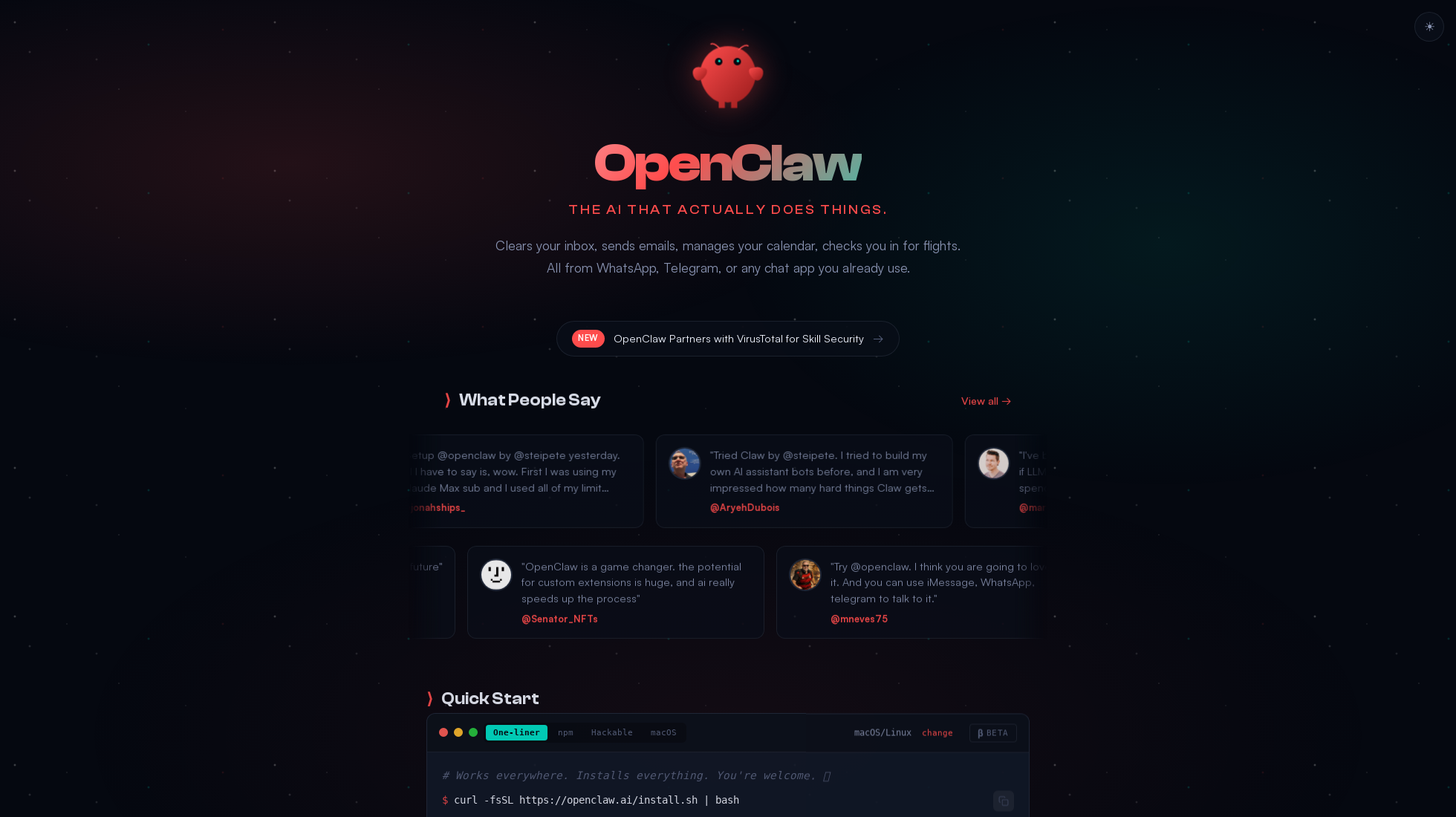
Development and distribution of an open-source personal AI assistant that runs locally on user devices (Mac, Windows, Linux). The software integrates with messaging platforms (WhatsApp, Telegram, Discord, etc.) to perform autonomous tasks, manage digital workflows, and control local applications.
Classification
Taxonomy version 2026-01.
Executive analysis
OpenClaw (formerly Clawdbot) is a viral open-source project that represents the cutting edge of 'agentic AI'—software that performs actions rather than just answering questions. Its primary strength is its ability to run locally and integrate deeply with a user's digital life via chat apps, offering a level of utility and privacy that commercial assistants like Siri or Alexa lack. However, this power comes with significant risks. The project has been criticized for its 'move fast and break things' approach to security, with researchers highlighting dangers in granting an AI full system access. The project's history is volatile, involving trademark disputes (forcing a rename from Clawdbot) and a wave of unrelated crypto scams exploiting its brand. Despite these challenges, the project has garnered a massive following and the creator, Peter Steinberger, has recently joined OpenAI, with the project transitioning to a foundation model. It is highly competitive for tech-savvy users willing to manage the risks but is currently not suitable for general consumers due to safety and usability hurdles.
Target market & audience
Product signals
- Runs locally on the user's machine, offering greater data privacy compared to cloud-only agents
- Open-source software with a 'hackable' architecture allowing for custom skills and extensions
- Persistent memory allows the AI to retain context and learn user preferences over time
- Integrates with major messaging apps (WhatsApp, Telegram, Signal, Discord, Slack, iMessage)
- Capable of executing complex tasks like browser automation, file management, and API interactions
- Free to download and use (excluding API costs for LLM providers)
- Requires technical knowledge for installation and configuration (CLI-based setup)
- High security risk due to granting the AI full system access (shell execution, file system read/write)
- Relies on third-party paid API keys (e.g., OpenAI, Anthropic) which can incur significant costs
- Potential for unintended destructive actions (e.g., accidental deletion of emails or files) due to autonomous nature
- Recent history of forced rebranding (Clawdbot -> Moltbot -> OpenClaw) and association with unrelated crypto scams
User sentiment
- Described as 'magical' and a 'game changer' for personal productivity
- Praised for being 'what Siri should have been' with actual execution capabilities
- Users appreciate the 'funny' and 'soulful' personality of the AI (Molty the lobster)
- High engagement from the developer community with rapid creation of new skills
- Valued for its ability to automate mundane tasks like email management and calendar scheduling
- Criticized by security researchers as a 'security nightmare' due to exposed ports and lack of sandboxing
- Reports of instability and bugs, including instances of the AI deleting user data without confirmation
- Complaints about the difficulty of completely uninstalling the software and its dependencies
- Confusion and frustration caused by scammers launching fake crypto tokens ($CLAWD) using the project's former names
- Some users find the setup process too complex or 'god-awful' compared to managed solutions